Showing posts with label lawquote. Show all posts

Wednesday, April 09, 2008

Welcome Back Global Warming

Two days ago, that water was snow.

I've read some fun legal decisions recently.

In Chuang v. Manning, 2008 CanLII 14175 (ON S.C.), Justice Corbett shuts down a vexatious litigant:

"Mr. Chuang should understand, now, that the justice system has decided his case and will not permit him to re-try those issues, now, or ever. It is over. Finished. It is time for Mr. Chuang to move on. "

I was also happy to see in two short decisions from Justice Lemon in the Central-West Region of the Superior Court that documents go missing there like they do in the courthouse in Ottawa some times. Justice Lemon had the courtesy in both of these decisions to apologize "on behalf of the administration of justice." A search for that phrases on CanLii turns up only those two decisions [1 2].

Friday, March 07, 2008

Farewell to Patently Unreasonable: Dunsmuir v. New Brunswick

It might seem like an ordinary day to you, but for Canadian administrative law nerds, everything has changed. Huge news today from the Supreme Court of Canada in Dunsmuir v. New Brunswick: All nine judges agreed that it is time for the "Patently Unreasonable" standard of review to be banished! There are only 2 Standards of Review! "Reasonableness.and Correctness" (With a 3-judge minority preferring "Deference and No Deference").

...it would be unpalatable to require parties to accept an irrational decision simply because, on a deferential standard, the irrationality of the decision is not clear enough.

Furthermore, they all agreed that the "pragmatic and functional approach" is out. We now have a contextual "standard of review analysis" from the 5-judge majority decision written by Justices LeBel and Bastarache. It uses the same factors that the pragmatic and functional approach used, but now they are not an exclusive list and one of the factors can be determinative.

All 9 judges wanted the standard of review question to be more straight-forward so that people challenging administrative decisions will better know what to expect and not have to pay such huge legal bills. Fortunately for us lawyers, we should still be kept busy with water muddied by the minority opinion from Justices Binnie calling for a "wider reappraisal" that accomodates "a lot of variables" and another from Justice Deschamps calling for clearing away "superfluous discussions and processes".

I always wonder what the tone of debate is between the justices when they don't all sign on to the same decision. I have a feeling that it might be at it's most heated when they agree on whether the appeal is upheld or not, like they did in this case (poor Mr. Dunsmuir won't be getting his job back), but don't agree on how to get to that answer.

One of the clues I go by to tell how heated things are is how often the writer of the judgment feels a need to mention that their opinion is held "with respect". In this case, Justice Binnie writing only for himself used the phrase twice. But the more telling quote may be:

Asking courts to have regard to more than one variable is not asking too much, in my opinion. In other disciplines, data are routinely plotted simultaneously along both an X axis and a Y axis, without traumatizing the participants.

I think it is a safe bet that the Justice and not one of his clerks wrote those sentences.

Thursday, January 10, 2008

Romance Advice from the Ontario Court of Appeal

Justice David Watt in R. v. Rahanam, confirming an offender's 9-month prison sentence followed by a period of 2-years probation rather than allowing the offender to serve his sentence in the community:

"Unlawful confinement, brandishment of a weapon and assault will not be tolerated as acceptable methods to rekindle a flagging romantic relationship."

Thursday, June 14, 2007

Yes, that's right, I'm a Lawyer

Lee Seshagiri, David Scrimshaw, Krista Scobie and Adrian Scofield applauding the people who helped them get to the Call to the Bar. Photo: K. Shore

I've had two full work days as a lawyer now. Underneath my name on my email signature it now says "Counsel". Yesterday in the Small Claims Court, Justice Tierney recognized me so I didn't get to introduce myself. But after I introduced my client, I said, "you can note me as counsel."

I've been giving out legal advice left and right. Examples: "Read the whole contract!" "Don't get caught!" and "If the officer who gave you the ticket shows up at your court date, plead guilty with an explanation."

After the ceremony on Tuesday, some of the new lawyers already had their documents framed. I expressed surprise and Mom explained there was a booth set up where they were getting it done and she'd seen parents ripping the envelopes out of their children's hands and taking them right over. "I imagine it is not inexpensive," I said.

"That's right," she said. "I figured you had a a bunch of binder clips at home to put them together."

Webshots Album of Photos taken by K. Shore

Wednesday, January 10, 2007

Dave's Excuses

It is Wednesday night. I stopped working before 7pm tonight and I did not stop at the Manx on my way home. No, I cycled right here. I put some clothes in the washer. I ate some leftovers. I checked my emails. I looked at the TV listings and determined that nothing is on that I need to watch. I played Mumu (a disappointing 435). And now I am creating a Blog Posting.

Yesterday, the organizing book review had the lead in the poll with 5 votes, but since then there have been two votes for "An explanation of why Dave hasn't posted in so long".

This is fine with me because I haven't had time to give the book the attention it deserves.

I haven't posted in so long because:

  1. I have 67 unanswered emails that should be dealt with before posting here because every one of those emails could be from one of you readers of my blog who is right now thinking, look he has time for this nonsense, but no time to reply to my thoughtful email.
  2. At the end of every year for many years now, I have done a review of major areas of my life and thoughtfully crafted attainable and measurable goals and resolutions for the new year. I have not done that yet this year and should do it before posting here.
  3. There is a new computer game in my life. It would be too embarrassing for me to reveal anything else about it.
  4. I have been working very hard. Lots of trials and settlement conferences this month to prepare for and conduct, no time off over the holidays. [Milestones: (a) Completed an entire trial, didn't get everything I asked for, but it mostly went the way I argued it should even though the justice of the peace found me confusing. (b) Successfully opposed a lawyer's motion to dismiss one of my cases and won - tip: "that would be a try-able issue" is a magic phrase in this situation. (c) Successfully moved for an adjournment of an appeal while a local lawyer who is often in the news opposed the adjournment - tip: being completely ignorant of the case is extremely helpful in this situation.]
  5. I had a cold this past weekend.
  6. Phil loaned me two tapes with Battlestar Galactica episodes. Plus Space TV showed the opening mini-series.
  7. I discovered Carl Schroeder. He is a terrific sci-fi writer who has written one book with bona fide space pirates (Sun of Suns), and two others that are close enough to count (Permanence and Vesta).
  8. I've actually spent some time with other human beings since the holidays started.
  9. Among last year's resolutions was: "Clean out the basement" This was the second or third year it was on the list without being performed. I should be working on that instead of blogging here.

Wednesday, September 27, 2006

Breaking News: I just met Justice Abella!


I don't want you to be too envious about my status as a student-at-law, but although I am neither young nor a lawyer, because I am articling, I am invited to events sponsored by the Young Lawyers' Division of the Ontario Bar Association.
Tonight they had a reception at the Rideau Club at which the Honourable Justice Rosalie Silberman Abella told us how she came to be appointed to the Supreme Court of Canada. It didn't surprise me that she was an engaging speaker because her written decisions are always a pleasure to read and if you ever watch Supreme Court TV, you'll see that she is always the judge who seems most interested.
She told us that she is sixty, and she decided she wanted to become a lawyer when she was 4 years old (because her lawyer father couldn't practice law when the family immigrated to Canada until he became a citizen, so he became an insurance man instead). That's 56 years of having a passion for law.
She also told us that she didn't have much of a dating life in her youth, but I find that hard to believe. Still... here are my top 5 reasons that it's okay that Justice Abella is married to someone else:

  1. She freely admits that she doesn't know who Mag Ruffman is, has never watched a home repair show, and doesn't know how to fix a thing around the house.
  2. She used to be a family court judge. When she got bored with me and divorced my sorry ass, I'd be lucky to wind up with a bicycle wheel in the settlement.
  3. Me: "Hi, honey, how was your day?" Her: "Quiet, just overturned a decision of the Ontario Court of Appeal, struck down a few pieces of legislation as unconstitutional and made it illegal to discriminate againt..., oh heck, enough about me, what were you dealing with today?" Me: "Pothole case... but it was a really big pothole."
  4. Her sons are younger than me and both experienced lawyers. They could beat me up for real and in court.
  5. She has seen every single one of the Police Academy Movies.
Oh, I almost forgot, her key to reaching the Supreme Court... at every step along the way when she was offered an interesting career choice, people advised her not to, but she did them anyway.
65% paycut to be a judge? Sure! Lead a Royal Commission on Equality in Employment that all the politicians and newspapers will hate you for? Sure! Chair the Ontario Law Reform Commission even though they're planning to kill it? Bring it on!
Her advice: "Don't take other people's advice."

Monday, June 05, 2006

Graduation

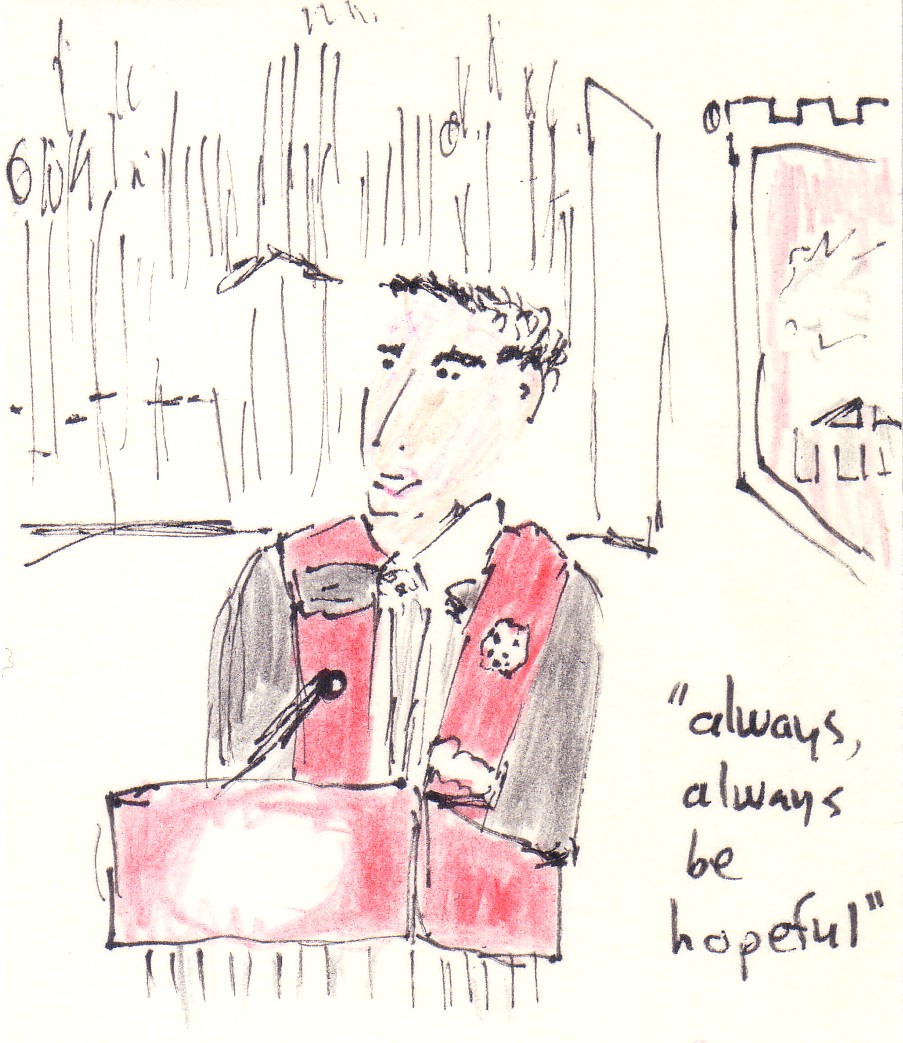
Always be hopeful says Premier McGuinty

I must say, it's impressive how well organized the people are who run the UofO convocations. Makes for a well-run graduation ceremony. The university gave Dalton McGuinty (Premier of Ontario) an honorary doctorate and in return he gave us an inspirational speech.

It wasn't actually as inspiring as the speech our classmate Adam Patenaude gave us on Saturday night at the Grad Gala, but Doctor McGuinty was brief. Everyone was happy about that.

How brief was he? I didn't have time to colour in the pipe organ or the UofO Crest on the podium.

Monday, May 22, 2006

Energy Drain - Bar Admissions and MuMu

I'd like to explain why I've had no energy for blogging or doing anything else these past few weeks.

I don't know if I'm allowed to talk about the bar admission course I'm taking. Everything we do seems to have a warning attached to it that goes like this:

Please note that all information prepared for this assessment process must be kept confidential. Failure to adhere to this paragraph may be regarded as "Academic Dishonesty" under s. 43(3) of the Licensing Process Policies.

For all I know, my sharing this note with you is such a breach. So let's just talk hypothetically. Imagine you're in a room with 24 people who have just completed their second or third university degree and you have an instructor asking them questions like "How do we communicate with our clients?"

And then the instructor waits for people to raise their hands. And keeps waiting.

And finally a hand goes up and the hand-raiser says, "on the phone? by email?"

"How else?"

I'm the guy who just shouts out "politely".

When the instructor didn't like that answer, I went back to being the guy who just shouts out the obvious answer right away so we don't have the long cricket chirping silences. Until the instructor asked "do we only write contracts so that the lawyers involved can understand them."

"No," I said.

"You don't have to answer so forcefully," said the instructor, "you could say, 'not necessarily'." Now we're back to the cricket chirping silences, because I'm not into unnecessarily equivocal answers.

Alas, as much as I've admired my fellow law student colleagues, I lost some of my optimism last week. Here's a sentence I used to begin a summary in a memo last week about a letter that our "firm" received by mistake:

This letter is like a live cobra that has been tossed through our window. It may have already bitten us, but if we handle it with care, we may escape further harm, get the anti-venom in time and possibly, but not likely, turn it to our advantage.

My fellow firm members deleted the sentence.

Do you see why I feel like my energy is being drained?

Don't play this game

MuMu: If you're smart, you won't click this picture.Then here at home, I came across that damned game MuMu because somebody asked if I could find something to occupy their mindNote1. I had my computer game addiction down to only about 20 minutes a day before this. A MuMu game takes me about 40 minutes. And when I finish one game, I want to play another. I must have spent six or seven hours playing it yesterday. And I'd promised myself I wouldn't play at all.

This morning I played two games and got a score of 653 on my second game. That's a darned high score and I'm hoping it will satisfy me enough that I never play it again. If you're smart, you won't follow the link I've imbedded into the screen shot.

Sunday, May 07, 2006

Party Hosts: Don't be too complacent about liability

If, like me, you follow law news and you host parties, you've been anxiously awaiting the Supreme Court ruling in Childs v. Desormeaux. The Court announced its decision on Friday. Bad news for the paraplegic Zoe Childs, good news for hosts. The media has been reporting it like this:

The Supreme Court of Canada ruled unanimously on Friday that hosts cannot be held legally liable for letting their guests drive home drunk. [CBC news]
But that isn't exactly what they said. Here's a quote from the unanimous decision written by Chief Justice McLachlin with a key phrase in bold:
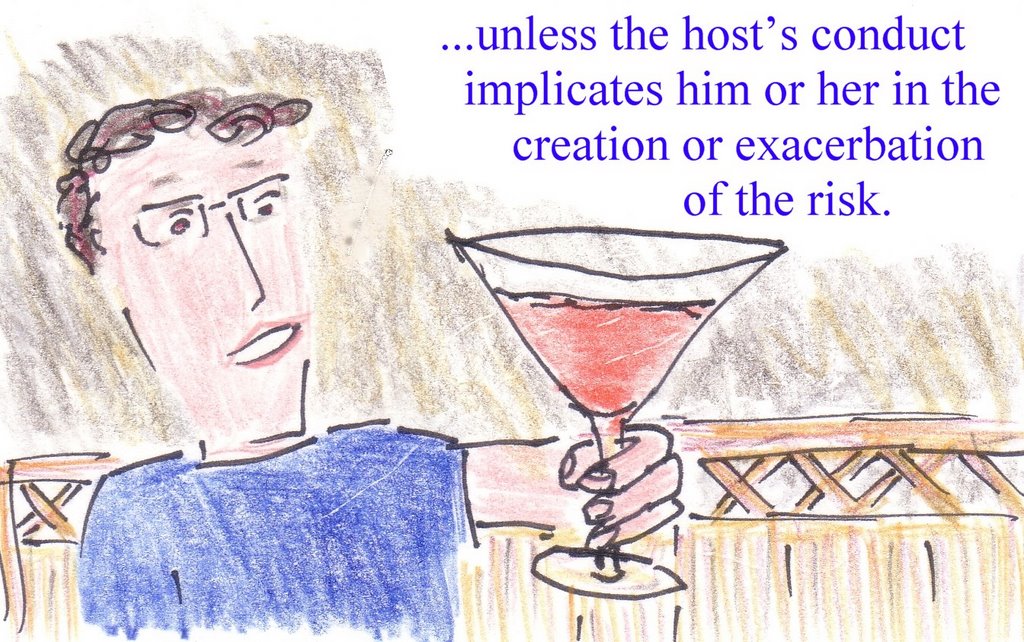
A social host at a party where alcohol is served is not under a duty of care to members of the public who may be injured by a guest’s actions, unless the host’s conduct implicates him or her in the creation or exacerbation of the risk.

The party that Desmond Desormeaux attended was a BYOB. Desourmeaux started drinking before he got to the party. At the party, he was mostly in a different part of the house from the hosts. He showed no obvious signs of being drunk in the hosts' presence. So, in this case, the hosts' conduct clearly didn't implicate them in the creation or exacerbation of the risk that Desormeaux posed to Zoe Childs and the other people in the car he hit.

What conduct would implicate hosts in the creation or exacerbation of the risk? The Supreme Court has given us no guidance on that topic.

If the conduct did implicate the hosts and give rise to a prima facie duty of care would public policy considerations such as the effect on insurance premiums negate the duty of care? The Court has left that question for another day as well.

My conclusions:

  • There is no change in the moral duty we hosts have to try to keep our guests from hurting themselves and others.
  • It's still a good idea to mix a weak Sangria, serve plenty of food, and have lots of non-alcoholic alternatives.
  • Collect the car keys if you ask Dave T to bring his Cosmo Kit because that just might create or exacerbate the risk.

Thursday, April 06, 2006

Legal Illustrations 6: Police Trickery, Use of the Body, Re-enactments

These are the last illustrations I will draw in law school lectures. There were few illustrations from me this semester because:

  1. I only took one lecture-format class based on case law; and
  2. That class was The Law of Evidence and almost all the cases involved sex assaults and that's just not a direction I want to take with my art.

Confessions

The leading case on the admissibility of confessions is R. v. Oickle. Oickle confessed to setting a bunch of fires, so I used a clip-art picture of a lit match in my first-year Crim summary. But this year I decided to pick up on a quote about "police trickery" from Former Chief Justice Lamer that Justice Iaccobucci adopts.

In general, a voluntary confession obtained through police trickery is admissible unless the police engage in conduct "that shocks the community." What tricks would shock the community? Examples include: "a police officer pretending to be a chaplain or a legal aid lawyer, or injecting truth serum into a diabetic under the pretense that it was insulin."

divider

Admissibility of Unconstitutional Evidence

Under paragraph 24(2) of the Canadian Charter of Rights and Freedoms evidence that is obtained in violation of the Charter is not admissible in court if the admission "would bring the administration of justice into disrepute." The 3-part test for this is set out in R. v. Stillman ("You know it's a good test when it has three parts", Nicholas McHaffie). The first part of the test is "would the admission of the evidence make the trial unfair?" It will be unfair if the evidence was "conscriptive" and could not have been obtained without the Charter violation. Examples of conscriptive evidence are compelled statements, compelled body samples, evidence discovered through "use of the body", or evidence discovered through the use of one of those.

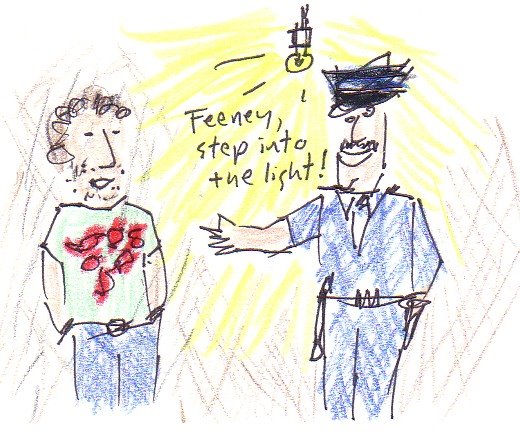
"Use of the body"? What does that mean? Suppose you're investigating a murder and you come to your suspect Michael Feeney in his trailer and you say, "hey, Feeney, step into the light." Then when he does, you see his shirt is covered in blood, you arrest him, the blood matches the victim, he's convicted. Does the fact that you told Feeney to step into the light count as "use of the body"? No. R. v. Feeney But if you made Feeney put a shirt on to see if it fit him and then had him re-enact the crime, that would be pushing it.

divider

Prejudicial Evidence

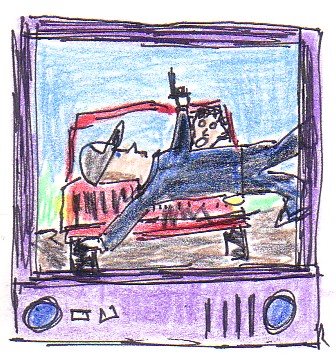
Speaking of re-enactments, suppose you're prosecuting some guys for driving into some cops in a "drug bust gone bad" and you video-tape a re-enactment in which you use bigger cars than the guys drove, you have them move at faster speeds, and you take other liberties to make your video exciting. Will you be able to show it to a jury so they can better understand what you are saying the alleged bad guys did? Probably not. The cardinal rule of admissibility of evidence is that the probative value has to outweigh the potential for prejudice, or the chance that it will help find the truth is greater than the chance it will lead away from the truth or unnecessarily complicate the trial.

In R. v. MacDonald the Ontario Court of Appeal decided a videotape like the one I just described would be more prejudicial than probative.

In balancing the prejudicial and probative value of a video re-enactment, trial judges should at least consider the video’s relevance, its accuracy, its fairness, and whether what it portrays can be verified under oath.

Wednesday, March 22, 2006

Names for Law-Nerd Rock Bands

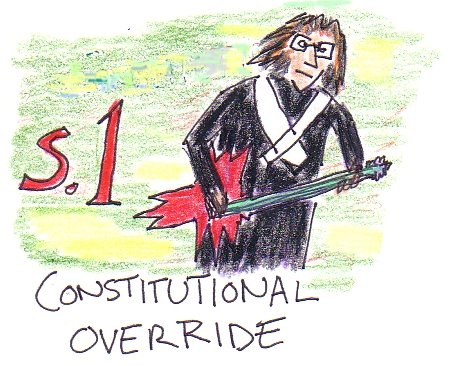
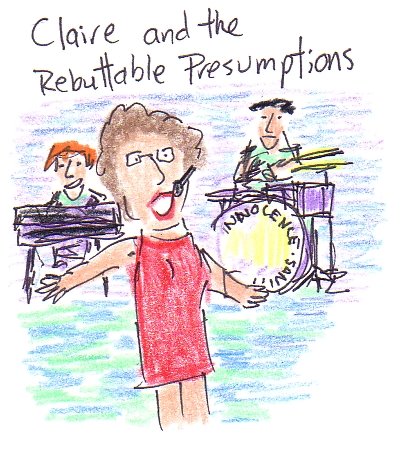
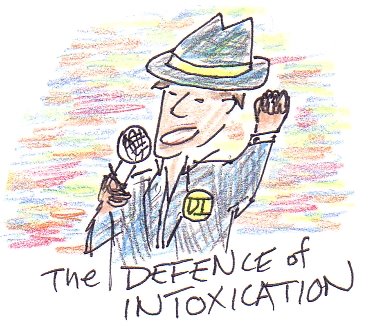
Constitutional OverRide -- Heavy Metal for a Free and Democratic SocietyIf any of you law students need a name for a band, here are several suggestions: The Defence of Intoxication - and we're talking about self-induced! Rebuttable? where is the air of reality?
Sunday, February 26, 2006

Ultraquistic Subterfuge: High class, first class, law class

I'm guessing that with photos of cats and birdfeeders, recipes for chicken dishes, and boot lace diatribes, some of you are wondering if I'm actually still going to school and learning things. Let me assure you that I am.

For example, this week, I learned that that the Chief Justice of the Supreme Court, the Right Honourable Beverly McLachlin, wrote this when she was a justice on the British Columbia Court of Appeal:

McLachlin C.J. Not the biggest advocate for equality perhaps, but she writes a clear rule usuallyIt may well be that generally discrimination cannot be justified in a free and democratic society. But it is not true that it can never be justified. Circumstances may arise where discriminatory measures can be justified. For example, in times of war, the internment of enemy aliens might be argued to be justifiable under s. 1 [of the Canadian Charter of Rights and Freedoms], notwithstanding the fact that this is discriminatory and would not be tolerated in peace time. [Andrews v. Law Society of British Columbia (1986) 27 D.L.R. (4th) 600 (B.C.C.A.)]
I wonder if she ever found herself at a social function or somewhere chatting with David Suzuki. I suspect he has thoughts on wartime internment that differ from hers.

Anyway, I know academic speculation is not what you want from me. You want legal tidbits that you can apply in your daily life. Therefore this week, from my Legal Drafting class, I bring you one of the ways that ambiguity can arise in a text:

Ultraquistic subterfuge -- equivocal repetition of a word

Ultraquistic subterfuge occurs when a writer uses a word to mean one thing in a sentence and then uses the same word to mean something different. Whether this is a problem will depend on the reader and the context.

Look at "sentence" in this example: "In the final sentence of her judgment, she gave the foreign-born Canadian an internment sentence." Most readers will take the first "sentence" to mean a string of words and the second "sentence" to mean a prison term. If we turn that example around: "She gave the foreign-born Canadian an internment sentence in the final sentence of her judgment," it becomes much less clear if the "internment sentence" was the last string of words in the judgment or was the last prison term mentioned.

Exercise: find or create demonstrations of ultraquistic subterfuge. Prizes may be awarded for particularly subtle or clever examples.

Friday, February 03, 2006

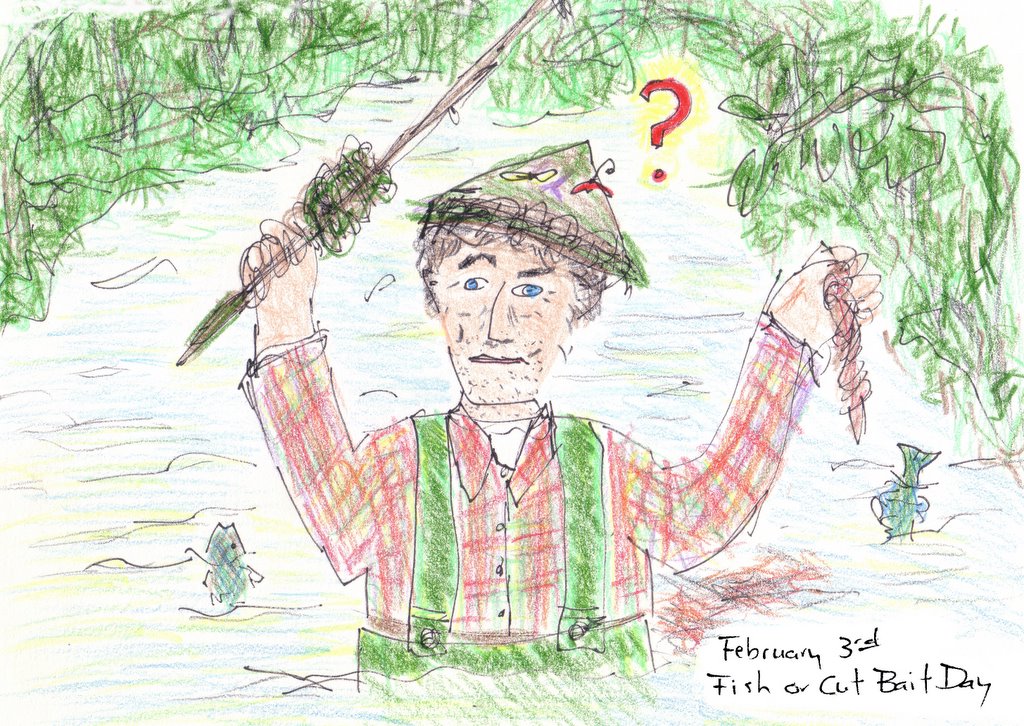
Happy Fish or Cut Bait Day


I hope you're all successfully navigating the hidden shoals and sandbars of the waters of February 3rd. [If you're in a relationship and don't know about Fish or Cut Bait Day, you might want to read this.]
My day is off to a good start. I just read a heart-warming law case {Hallmark Financel Insurance Brokers Ltd. v. Fraser & Beatty and McNairn (1990) 1 O.R. (3d) 641 Ontario Court (General Division)} in which a client sued a lawyer because the lawyer misunderstood an instruction and cost the client $62,000 on the purchase of a business. The judge said that the lawyer, McNairn, had done nothing wrong because his interpretation of the instruction was reasonable and the client had plenty of opportunity to catch and correct the mistake.
So, commenters, what's your favourite way to start a break-up conversation? "We need to talk"?

Wednesday, February 01, 2006

New Invention: Chocolate Yogourt Pudding

I had my first class of the Winter semester today, Legal Drafting. This means that I'll be posting drawings again soon. (I'll get to the pudding in a minute.) I actually did a drawing in class today. I didn't colour it because it's a small class and the prof doesn't know me yet. I thought he might think I'm bored if he sees me take out my coloured pencils.

So I'll colour the picture tomorrow in Evidence.

The Legal Drafting prof gave us a quote I like:

The goal of the legislative drafter is not to draft a law that a reasonable person can understand.

Instead, it is to draft a law that an unreasonable person cannot possibly misunderstand.

When I got home from school, I decided to boil up some dumplings and broccoli. (I'm coming to the yogourt pudding really soon.) I got the broccoli stem pieces boiling, came up, read some emails and then went back downstairs to add the dumplings. Guess what! I'm out of dumplings. Time to buy more. So my supper was what I believe would be an Atkins-friendly meal of broccoli with spicy peanut sauce. [Dumpling and broccoli instructions here.]

That's when it occurred to me that tonight would be the perfect night to try making yogourt pudding. (I told you we'd get there.)

Ever since I made the Toxic Waste for Halloween, I've been thinking about fun things to do with pudding. I bought a few boxes at the Loblaws on Saturday and just after I bought milk to add to it, I walked past the yogourt section and thought, hey!

750g of (plain) yogourt is just more than 500ml which is how much milk you're supposed to add to the instant pudding. So I just mixed it all together. At the first scent of the yogourt, I thought, oh, no, this is not going to work. But I didn't let that stop me. I kept going with the mixer for the full two minutes. Then I put the bowl in the fridge. Wait, no, first I took a taste of the pudding from the beaters. It tasted good. I removed the beaters from the mixer, licked them off, threw them in the sink and then put the bowl in the fridge.

Five minutes later, I scooped some into a dessert bowl. It had a nice thick pudding consistency and a rich flavour. Almost like a soft cheese cake taste.

But here is the thing that has me really excited. By the time I finished the bowl, I felt like I'd had enough. If that had been ordinary pudding, I would have wanted more. Lots more.

Tuesday, January 24, 2006

Recycling does not equal Destruction

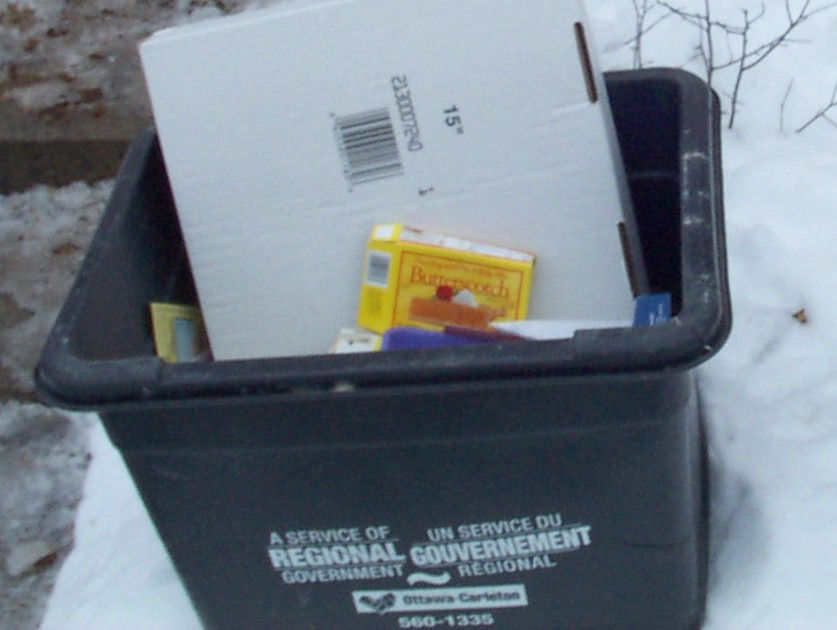
Recycling - anyone can learn I use store brand pudding

You'll be happy to know that I'm back on task and researching away. This morning's perambulations took me to the web site of Ontario's Information and Privacy Commissioner. (Which, by the way, is fairly well designed and useful on the topics of access to information and privacy.)

I was happy to find absolutely nothing on my area of study. (I'm at the point where I don't need any more material, I just have to make sure I haven't left out anything important, like say an order from the IPC that is directly on point.)

What I found was the one order that appears to have been made under Ontario's relatively new Personal Health Information Protection Act. If you're like me, you've always figured that the big danger with confidential material going in your recycling box is that a neighbour might come along and find out your Visa number or learn that you've got a prescription for anti-fungal medication. Because once it goes to the recycler, it gets turned into mush and then paper towels or toilet paper. Right?

Not necessarily. Last fall, several boxes of medical records wound up blowing around an outdoor movie location in downtown Toronto because a disposal company truck driver assumed that because they weren’t in the "shredding" box, they were for general recycling and then the recycling company sold the boxes to a film company that needed lots of papers blowing around.

Here's what Anne Cavoukian, Ph. D., Information and Privacy Commissioner of Ontario, says about recycling:

Let there be no mistake: recycling does not equal secure disposal. In the recycling process paper is collected based on its specific type and stored in warehouses for lengthy periods of time until enough has been accumulated to make a sale. ... Once an organization has discarded or sold its documents to a vendor, or a vendor has sold those documents to a processing plant, there is no guarantee how those documents will be handled or who to contact in case of a breach. [HO-001 ]

If you're ever on a movie location, and you see a lot of menus from Ricardo's with the $2-off coupons torn out, you'll know that someone got their hands on my recycling bin. But you won't find my credit card slips. They get burned in the fireplace.

Monday, January 23, 2006

Mandate of Heaven

I was just poking around in law wikis when I came across this definition that seemed appropriate for an election day.

'Great balls of fire' by Butterme

Mandate of Heaven [From Wikilaw] A term of Chinese origin.

Traditionally, the Chinese emperors were considered to rule by divine right, but the recurrence of disasters under an emperor would be a sign that the emperor had lost the mandate of heaven, that is, that he could be deposed without fear of divine retribution.

In modern times, the non-Chinese use of the term is metaphorical, usually to signify that a current ruler's policies are disastrous, and that he too has lost the mandate of heaven and should therefore lose the next election.

Wednesday, January 11, 2006

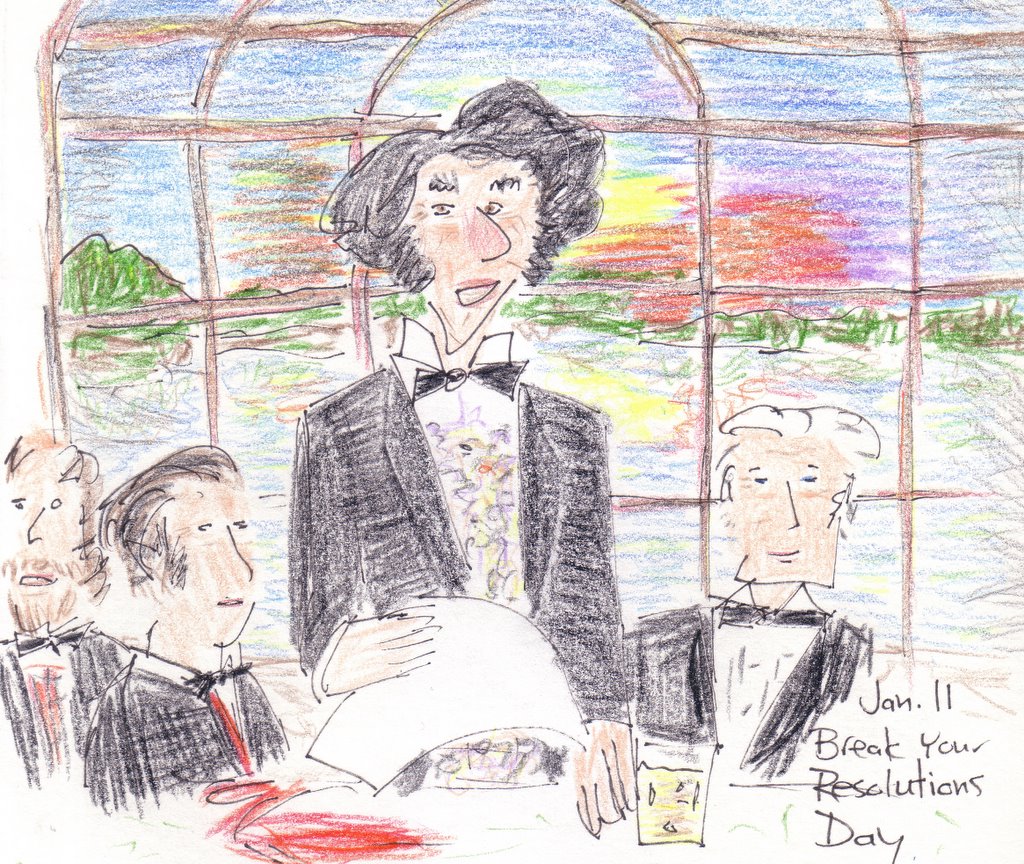
Happy Sir John A MacDonald's Birthday

Notice the glass? It's in the Robert Harris original, but not the copies!Today is the day we Canadians celebrate our first Prime Minister's Birthday. The records indicate he was born on the 10th, but he celebrated it on the 11th. This is a very Canadian thing to do. We celebrate Thanksgiving in October, we have our Hockey playoffs in late June or early July. Elections can happen anytime. The traditional way to celebrate Sir John A's birthday is to break a New Year's resolution. Perhaps this is because if he ever made a resolution about drinking, he broke it often. Here is what Wikipedia says about Sir John A. MacDonald and alcohol:

Macdonald was well known for his wit and also for his alcoholism. He is known to have been drunk for many of his debates in parliament. One famous story is that during an election debate Macdonald was so drunk he began vomiting violently on stage while his opponent was speaking. Picking himself up Macdonald told the crowd, "see how my opponent's ideas disgust me."
In another version of the story, he responded to his opponent's query of his drunkenness with "It goes to show that I would rather have a drunk Conservative than a sober Liberal." [Wikipedia Entry]
In any case, Sir John A set a different sort of tone for our country than George Washington set for his. {This posting may contain statements that lack support in available evidence.}

Tuesday, January 10, 2006

Judges and Privacy

Because I'm doing this "directed research" (or independant study) until my classes start in February, you're not likely to see many cartoons here this month. What am I studying? Why, thank you for asking. I'm looking at the use of mental health records in civil litigation here in Ontario. You might be surprised at just how much of your most private information can be seen by all sorts of people if you get involved in a lawsuit where your mental health is an issue. Some judges understand the importance of privacy, but in my reading of cases, I'm starting to get the idea that some judges don't get it. In a case I read today, which you can find on Quicklaw if you've got an account, a couple are suing for the psychiatric trauma suffered by the wife after she was injured in a car accident. They tried to keep her psychiatric records from both before and after the accident out of the list of documents the other side could see. The judge turned down their request and found it necessary to add details like this in his judgment:

The Plaintiffs did not sleep together in the same room for one-and-a-half years following the accident. In October 1996, [the husband] started to sleep in their son's bedroom because of stress and problems with intimacy. The Plaintiffs are in the initial stages of separation.
Where I've got "[the husband]", the judge has the name spelled out. I can't figure out why the judge thought he needed to include this background in his reasons for denying their wish for privacy, unless he really wanted to teach people a lesson about suing people and maintaining privacy.

Wednesday, December 21, 2005

One Semester Left

At 1pm when I was printing my summary for my 2pm exam and the computer said "printer is out of black ink" I really thought I was going to have a problem. But after pressing all the buttons on the printer and making it start again, I managed to print the odd pages as well as the even pages. Then at 2pm when I went to my section on Oppression and saw that the footnotes with case names and quotes weren't there, I had another bad moment. But the only quote I really missed was from the Wise Brothers.

"The fact that creditors’ interests increase in relevancy as a corporation’s finances deteriorate is apt to be relevant to, inter alia, the exercise of discretion by a court in granting standing to a party as a “complainant” under s. 238(d) of the CBCA as a “proper person” to bring a derivative action in the name of the corporation"
I got something close, like "vicinity of insolvency". But it's all over. I probably passed. "Inter alia" by the way, is Latin for "among others". Many judges and law professors prefer to say "inter alia" instead of the English equivalents. They save two letters. On the other hand, we all have to fuss around putting the Latin into italics and I think they're actually required to write in either French or English. But I'll leave it to someone else to bring that to the attention of Justices Major and Deschamps.

Tuesday, December 20, 2005

Legal Illustrations 5

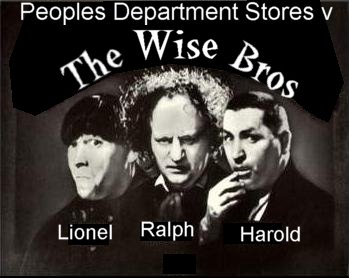
Peoples Department Stores Inc. (Trustee of) v. Wise, [2004] 3 S.C.R. 461

  • The corporations' interests are not to be confused with the interests of the creditors or those of any other stakeholder.
  • s. 122(1)(a) of the CBCA requires directors and officers to act in good faith and honestly vis-à-vis the corporation.
  • An honest and good faith attempt to redress a corporation’s financial problems does not, if unsuccessful, qualify as such a breach
  • The fiduciary duty does not change when a corporation is in the nebulous “vicinity of insolvency”
  • There is no need to read the interests of creditors into the fiduciary duty set out in s. 122(1)(a) in light of the availability under the CBCA both of the Oppression remedy and a Duty of Care action

You know, I couldn't find a real picture of the Wise Brothers, or a decent picture of a People's Department Store. So what was I supposed to do? I know the exam is tomorrow and I'm not even at 60% on my summary, but this is an important case. It deserves its own illustration.